
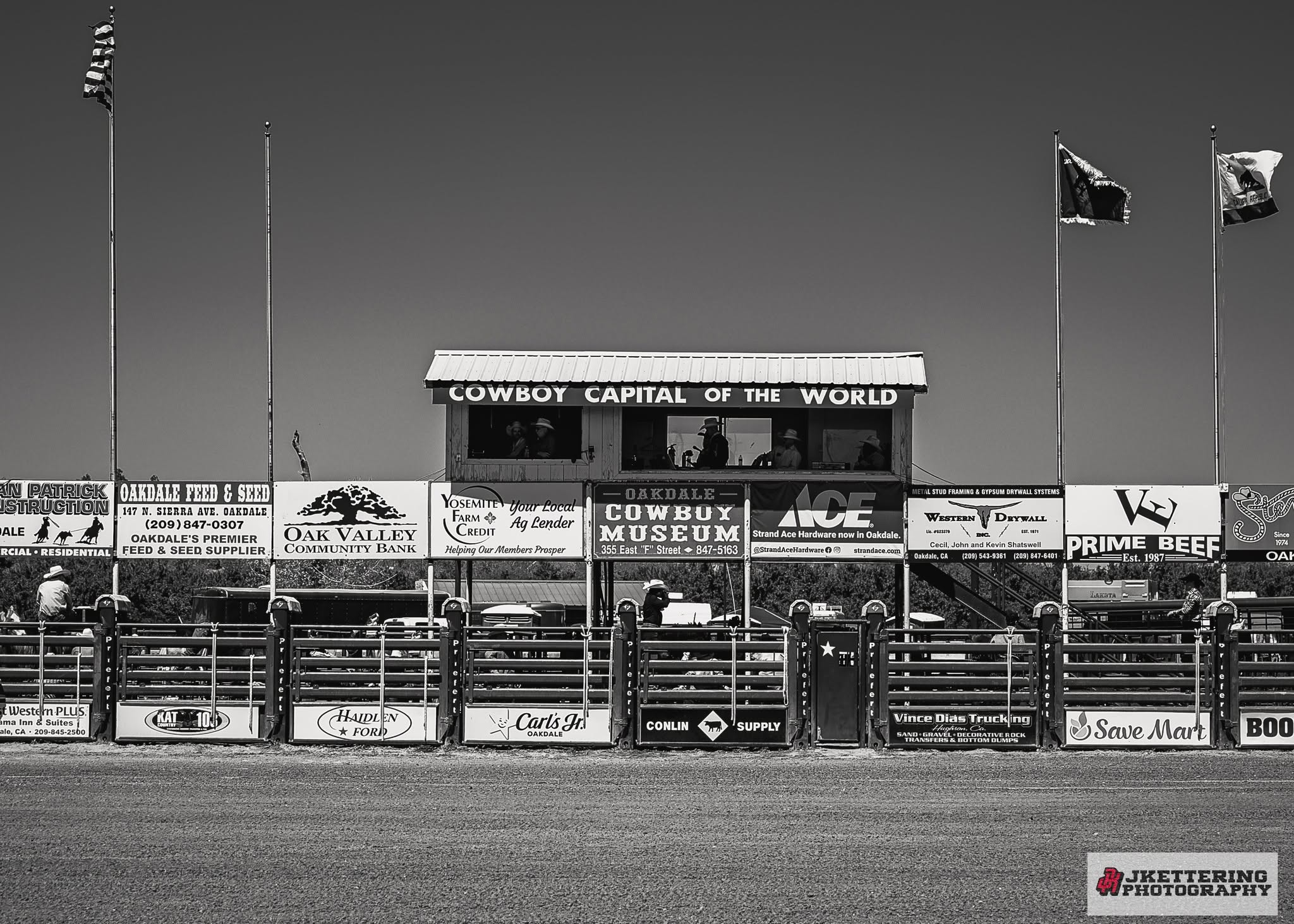
Every April, thousands of people make their way to Oakdale for one reason—to experience the Oakdale Rodeo.
They come for the excitement of professional rodeo competition, the traditions that have endured for generations, and the unmistakable feeling that they've stepped into a place where the western way of life is still very much alive. Today, Oakdale proudly wears the title "Cowboy Capital of the World," but that reputation wasn't created overnight. It was earned through decades of hard work, community spirit, and an unwavering commitment to preserving the traditions that built the American West.
The story of the Oakdale Rodeo is ultimately the story of Oakdale itself.
"Some rodeos are events. The Oakdale Rodeo is a legacy."
A Vision That Began in 1945
Following World War II, Oakdale was already known for its deep ranching roots and horse culture. Local horsemen recognized the importance of preserving those traditions while creating opportunities for families and competitors to gather around the sport they loved.
In 1945, that vision became reality when the Oakdale Saddle Club was founded. Rather than simply organizing horse events, the founders dreamed of creating a permanent home where rodeo, horsemanship, and community could flourish together. The Saddle Club purchased approximately 20 acres on the east side of Oakdale and began building stables, livestock chutes, grandstands, a half-mile racetrack, and a rodeo arena—laying the foundation for what would become one of California's premier rodeo venues.
The men and women behind that effort weren't simply building an arena.
They were building a tradition.
The First Clover Round-Up
On May 19, 1946, the Saddle Club hosted its first major event—the Clover Round-Up. What began as an amateur rodeo featured eleven events, including calf roping, bull riding, saddle bronc riding, bareback bronc riding, trick horse performances, team roping, and even wild cow milking. Entry fees were just a few dollars, and first-place prizes ranged from $10 to $50.
What happened next surprised everyone.
Oakdale's population at the time was only about 3,435 people, yet more than 4,500 spectators attended the inaugural event. The crowd actually outnumbered the town itself—a remarkable sign that something special had begun.
That first Clover Round-Up proved that the community wasn't just ready for a rodeo.
It was ready for a tradition.
"When more people attended the first rodeo than lived in Oakdale, history was already being written."
From Local Competition to Professional Rodeo
As word spread throughout California, Oakdale quickly gained a reputation for producing quality rodeo events and attracting talented competitors.
In 1948, legendary rodeo promoter John Bowman, a three-time World Champion who would later be inducted into the ProRodeo Hall of Fame, partnered with John Markham to produce the Oakdale Stampede. Their involvement elevated the profile of rodeo in Oakdale and helped establish the community as a destination for serious western competition. Today, the Oakdale Saddle Club honors Bowman's legacy by presenting a perpetual trophy to the rodeo's All-Around Cowboy each year.
The momentum continued to build. In 1954, the Oakdale Saddle Club produced its first professional rodeo while still using the Clover Round-Up name. Three years later, in 1957, the event officially became known as the Oakdale Rodeo—the name that continues to represent excellence in California rodeo today.
Earning the Title "Cowboy Capital of the World"
Oakdale's reputation extended well beyond a successful annual rodeo.
Throughout the 1950s and 1960s, the community became home to an extraordinary number of accomplished cowboys, horse trainers, ranchers, and rodeo champions. As more professional competitors called Oakdale home, the town earned a reputation unlike any other in California.
By 1960, Oakdale proudly embraced the title "Cowboy Capital of the World." It wasn't simply a slogan. It reflected a community where ranching, horsemanship, agriculture, and rodeo were woven into everyday life.
That title remains just as meaningful today.
More Than a Weekend of Rodeo
While the action inside the arena captures the attention of thousands each year, the Oakdale Rodeo has always been about something much larger than competition.
It's about neighbors working side by side to prepare the grounds.
It's about volunteers giving countless hours to preserve a cherished tradition.
It's about businesses welcoming visitors from across the country.
It's about families returning year after year, sitting in familiar seats, sharing the same stories, and introducing another generation to the excitement of rodeo.
Today, the Oakdale Saddle Club has grown to more than 400 members, many representing families whose involvement spans multiple generations. Their dedication ensures that the traditions established in 1945 continue to thrive nearly eight decades later.
"Traditions don't survive because they're old. They survive because people continue choosing to protect them."
A Living Celebration of Western Heritage
One of the reasons the Oakdale Rodeo has endured is because it has never forgotten its roots.
The events spectators enjoy today—team roping, tie-down roping, saddle bronc riding, steer wrestling, barrel racing, and bull riding—are all rooted in the practical skills that working cowboys relied upon every day. Rodeo preserves those traditions while showcasing the incredible athleticism of both horse and rider.
Just beyond the arena, the Oakdale Cowboy Museum continues preserving photographs, artifacts, stories, and memorabilia that celebrate the ranching families and rodeo champions who shaped the community. Together, the museum and the Oakdale Saddle Club help ensure that western heritage remains something to experience—not simply something to read about.
The Tradition Rides On
Much has changed since the first Clover Round-Up in 1946.
The crowds have grown.
The competitors now travel from across the nation.
The prize money has increased.
The event has become one of California's premier professional rodeos.
Yet the heart of the Oakdale Rodeo remains remarkably unchanged.
It is still powered by volunteers.
It is still rooted in community.
It still celebrates the values of hard work, family, sportsmanship, and western heritage.
Most importantly, it still brings people together.
Every April, longtime fans return to relive cherished memories while another generation walks through the gates for the very first time. Those first-time visitors become lifelong fans, and those lifelong fans become the next generation of storytellers who will pass the tradition on.
Because that's the true legacy of the Oakdale Rodeo.
It's never been measured by buckles or trophies.
It's measured by the generations of families who continue to call it their rodeo.
"The arena may host the competition, but the tradition belongs to everyone who walks through its gates."

0 Comments